
When trust is higher, life is better
Many factors contribute and interact in the formation of social trust – similar to the factors that shape our health. In health – genetic, environmental, social, behavioral. In trust – economic, demographic, exogenous events, country of origin and early experiences, etc. We cannot control for all the (pre-disposing, circumstantial, etc.) factors that shape our health. Nevertheless, we can focus on certain actions that can make a very significant difference.
Where trust is low, or we are not managing for trust, challenges can push people apart. The more we push apart, the more mistrust becomes polarization. Polarization turns into contempt, and contempt can turn into conflict. It brings out the worst that human beings are capable of — where we want to defeat one another rather than work together to achieve something bigger.
Social connection builds social trust
Social connection and disconnection are deeply intertwined with the level of social trust in a community — they influence not only how people feel about one another but also how societies function, govern, and sustain cooperation.
When people feel connected — through shared spaces, experiences, or relationships — they develop a sense of mutual understanding and predictability. In short, connection is the medium through which trust circulates.
Disconnection — physical, digital, or emotional — weakens the very conditions under which trust grows. So, where disconnection grows, social trust decays — and with it, the collective capacity to act together.
The relationship between connection and trust is cyclical:
- Connection → Trust → Cooperation → More Connection
- Conversely, Disconnection → Distrust → Withdrawal → Further Disconnection
Communities that deliberately design for connection — inclusive public spaces, transparent communication, shared projects — can reverse the cycle and rebuild trust from the ground up.
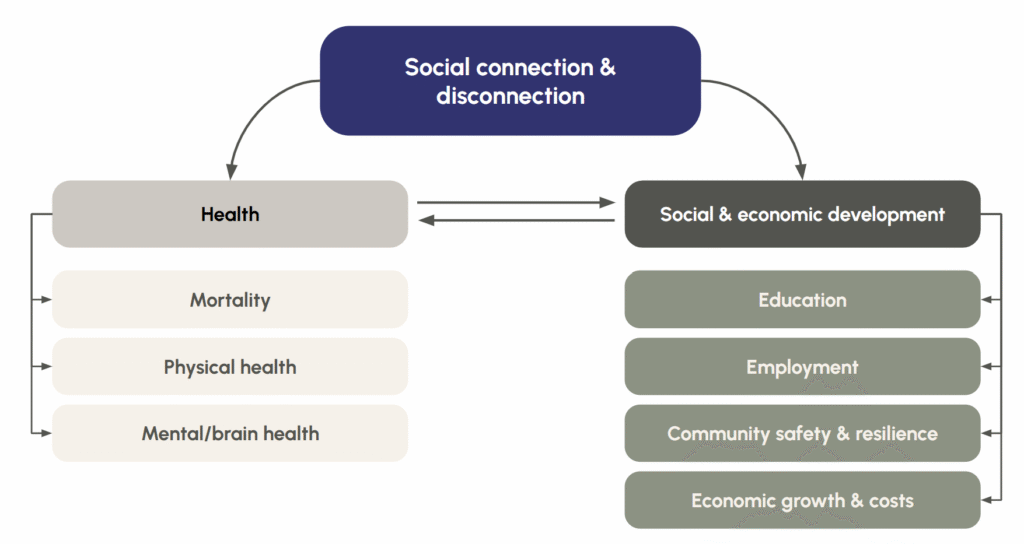
Social connection should be made a top priority in politics and policy, and leaders should be brought together to support it.
The WHO Commission on Social Connection Report
When social trust is higher…
Health is better
A 2018 meta-analysis of 150 studies conducted in 22 countries with a total sample size of over 300,000 participants found that higher levels social trust were associated with:
- 17% lower risk of mortality
- 35% lower risk of cardiovascular disease
- 34% lower risk of mental health problems
Healthcare costs are lower
A US study found that even after controlling for factors such as age, gender, income and health status, people in the top quartile of social trust compared those in the bottom quartile were:
- 17% less likely to have needed a doctor in the past year
- 26% less likely to have been hospitalized in the past year
Educational performance is stronger
A study of 15-year old students across 35 countries found that after controlling for other variables like national income etc, a one-unit increase in social trust was associated with:
- 13% increase in math scores
- 12% increase in reading scores
- 10.5% increase in science scores
A US study found that a one-unit increase in social trust correlated to:
- 5.5% increase in high school graduation rates
- 2.5% decrease in dropout rates
Crime is lower
There is ample evidence to show that social trust has a significant bearing on rates of crime. While controlling for other demographic and economic factors, a one standard deviation increase in social trust has been associated with:
- 28% decrease in violent crime rates (50 US cities)
- 21% decrease in hate crimes (30 European countries)
- 15% decrease in fear of crime (23 European countries)
Employees do better
Different studies of trust in the workplace have found both employee wellbeing and productivity are strongly influenced by levels of trust within their organization. For example, compared with people at low-trust companies, people at high-trust companies reported:
- 74% less stress
- 50% higher job satisfaction
- 50% higher productivity
Research to estimate the relative values of financial and non-financial job characteristics has found a “strikingly large” value for workplace trust. In terms of impact on overall life satisfaction:
- a 10% increase in trust ≈ 35% increase in monetary income
Social trust as a democratic tool
Raising social trust levels is good for everyone — but research shows that it has the most significant well-being payoff for those who are the least advantaged. This has profound implications for some of our social programs and policies. Just as there are severe inequalities in wealth, there are also severe inequalities in subjective wellbeing. It is true for everywhere. Deprivation, disability and poor health, unemployment, discrimination and exclusion … it is no surprise that these affect subjective wellbeing.
What is a surprise, what we should all take very seriously, is that by taking measures to raise levels of social trust in local areas of high deprivation and disadvantage, we may be able to significantly reduce the well-being inequalities in our society.
Social trust is not a magic bullet. But it is fundamental to our wellbeing. It matters. It is a kind of social fitness. And just as we need to pay attention to our personal fitness in order to remain healthy, resilient and functional, we need to pay attention to our social fitness.
Our experience from our pilot study in a disadvantaged neighborhood, showed us that civic stakeholders working on the frontlines feel neither pessimistic nor passive about the chances for growing social trust in their communities. The local ground is fertile.

Learn more
Would you like to learn more about social trust and its impact on communities, we recommend reading these reports:
Contact Us
We are as ambitious about addressing social trust as the world has been on addressing climate change. If you believe increasing social trust is paramount in this day and age, you have come to the right place. Get in touch with us to find out how we can work together on this big task.


